C
cosmok
Registrierter Benutzer
- 17.04.26
- 21.04.12
- 1.780
- 3.048


Folge dem Video um zu sehen, wie unsere Website als Web-App auf dem Startbildschirm installiert werden kann.
Anmerkung: Diese Funktion ist in einigen Browsern möglicherweise nicht verfügbar.


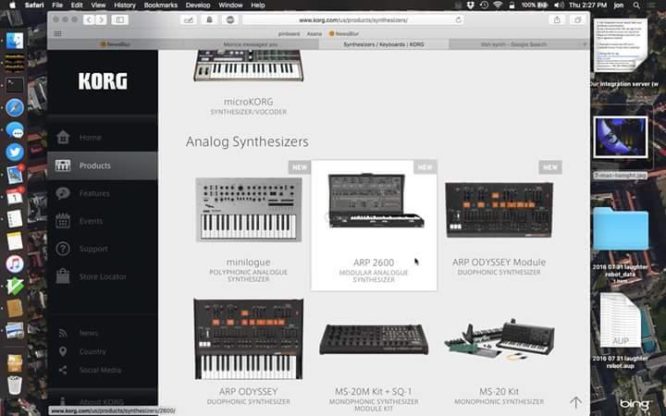
The Korg ARP Odyssey Modules offer all the editing and sound-shaping parameters from the keyboard versions, but in a format designed to fit into DAW and hardware-centric music production environments.
The compact module form factor has both CV/GATE to interface with analog desktop racks and synths, and USB and 5-pin MIDI for interfacing with controllers and DAWs.
The lineup includes two models, the white Rev1 and the black and orange Rev3, reproducing traditional styling.
Since its appearance in 1972, the ARP Odyssey has earned its reputation as a classic analog synthesizer. Forty years later, in 2015, with the advisory assistance of David Friend, co-founder of the ARP Instruments company, Korg resurrected the ARP Odyssey with a complete reproduction of the ARP Odyssey’s original circuitry. With the new Odyssey Module, Korg has further broadened the reach of the classic ARP Odyssey design.
ARP ODYSSEY Module Specifications:
Maximum Polyphony – 2 voices for duophonic; normally monophonic
Controllers –
Transpose Positions: 2 octaves down, normal, 2 octave up
Proportional Pitch Control:
b (Pitch down) Pad: about – 2 / 3 octave
– (Modulation) Pad
# (Pitch-up) Pad: about +2 / 3 octave
Noise Generator – Noise Spectrum Types (white and pink)
Portamento –
Maximum Speed: about 0.01 msec./oct
Minimum Speed: about 1.5 sec./oct
VCO (Voltage Controlled Oscillator)
Waveforms:
Sawtooth, Square, Pluse (Dynamic Pluse)
Frequency Range:
VCO-1 in low freq. mode, 0.2 Hz – 20 Hz: VCO-1 and VCO-2 (audio range) about 20 Hz – 20 kHz
Warm Up Drift:
1/30 semitone from turn on max
Pulse Width:
50 % – 5 %
Pulse Width Modulation:
ADSR, +45 %; LFO, +15 %
Voltage Controlled Response:
1 V/oct
Maximum Frequency Shifts:
LFO sin wave, +1/2 oct.; LFO square wave, +1.5 oct.; ADSR, +9 oct.; S/H, +2 oct.
* VCO-1 is low note priority, VCO-2 is high note priority.
VCF (Voltage Controlled Filter)
Types:
Low pass (I: 12 dB/oct., II III: 24 dB/oct.)
Frequency Range:
16 Hz – 16 kHz
Maximum Usable Q:
30
Resonance:
1/2 – self oscillate
Voltage Controlled Response:
C3 key (left edge): 0 V, C6 key (right edge) 3 V
VCA (Voltage Controlled Amplifier)
Dynamic Range:
80 dB
Ring Modulator
Type:
Digital
Input Signal:
VCO-1, VCO-2 (square wave)
Sample & Hold
Command Sources:
Keyboard or LFO trigger
Sampled Signals:
VCO-1 sawtooth wave and square wave, VCO-2 square wave and pink noise
ADSR Envelope Generator
Attack Time:
5 msec. – 5 sec.
Decay Time:
10 msec. – 8 sec.
Sustain Level:
0 – 100 % or Peak
Release Time:
15 msec. – 10 sec.
AR Envelope Generator
Attack Time:
5 msec. – 5 sec.
Release Time:
10 msec. – 8 sec.
Control Input Jacks
Pedal:
6.3 mm monaural phone jack
Portamento Foot Switch:
6.3 mm monaural phone jack
Audio Output Jacks
LOW:
Connector:
6.3 mm monaural phone jack
Maximum Output Level:
-20 dBu@ 10 k ohm load
Output Impedance:
10 k ohm
HIGH:
Connector:
XLR connector
Maximum Output Level:
+4 dBu@ 1 k ohm load
Output Impedance:
330 ohm
Headphones Jack
Connector:
6.3 mm stereo phone jack
Maximum Output Level:
50 mW + 50 mW@ 33 ohm load
Output Impedance:
10 ohm
* Controllable by volume knob.
External Audio Input (Ext Audio Input) Jack
Connector:
6.3 mm monaural phone jack
Maximum Input Level:
-10 dBu
Input Impedance:
22 k ohm
MIDI Connector
IN
USB Connector
Type B
CV IN/OUT Jacks
Keyboard CV (IN/OUT):
1 V/oct.
Connector:
3.5 mm monaural phone jack
GATE IN/OUT Jacks
GATE IN:
+3 V (minimum)
GATE OUT:
+10 V, key down; 0 V all keys up
Connector:
3.5 mm monaural phone jack
TRIG IN/OUT Jacks
TRIG IN:
+3 V pulse min., 10 ?sec. Duration minimum
TRIG OUT:
+10 V pulse on key depression, 10 ?sec. Duration
Connector:
3.5 mm monaural phone jack
Power Supply
AC adapter jack (DC 9V)
Power Consumption
6.5 W
Dimensions (W x D x H)
502 x 230 x 120 mm / 19.76” x 9.05” x 4.72”
Weight
4.5kg / 9.92 lbs.
Included Items
AC adapter, phone cable, mini-phone cable
Accessories
Expression/Volume Pedal:
XVP-20
Volume Pedal:
VP-10
Pedal Switch:
PS-3
Pedal Switch:
PS-1
Pricing and Availability
The Korg ARP Odyssey Module Rev 1 and Rev 3 will be available October of 2016 for $599.99 (US) each.

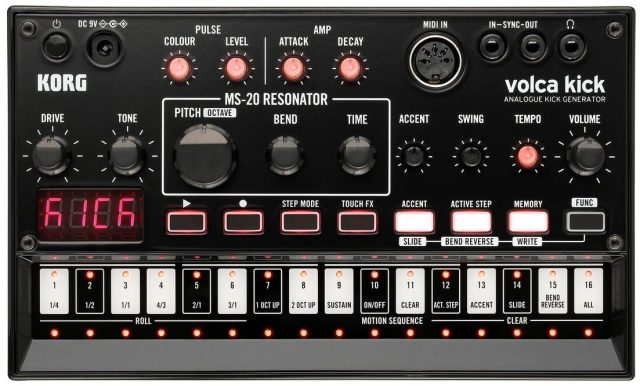
The Korg Volca Kick is ‘all about massive kicks, toms, and basses’, according to the company. It starts with a true analog oscillator and offers drive and MS-20 resonator circuits to shape ‘earth-shattering sounds’ that can be played and sequenced chromatically.
As opposed to generating sounds using a typical sine wave, the Volca Kick starts with the sound of an oscillating filter from the original MS-20. The filter of the MS-20 self-oscillates when resonance is increased to the maximum, and this is used to produce powerful kick sounds, ranging from solid kick drums to crisp kick basses with complex overtones.
The Volca Kick’s 16-step sequencer has a new Touch FX feature, which provides one-touch sequencer variations and time division, to introduce more live performance potential.
The pattern chain function lets you connect multiple sequence patterns for successive playback, making it possible to construct large-scale productions of 32, 64, or even 256 steps, by joining up to 16 sequences.
“Like all volcas, kick has a personality all its own, and combining it with other volcas or any other hardware adds unique character to users’ setups,” says Korg’s James Sajeva. “The familiar Audio Sync connection means it plays exceptionally well with other volcas, minilogue, electribe and SQ-1, and the MIDI IN jack lets you use the volca kick as a sound module via DAW or MIDI controller.”
With its compact size, battery operation, and built-in speaker, the volca kick can be taken anywhere.
Pricing and Availability
The Korg Volca Kick will be Available in October of 2016 for $159.99. See the Korg site for details.
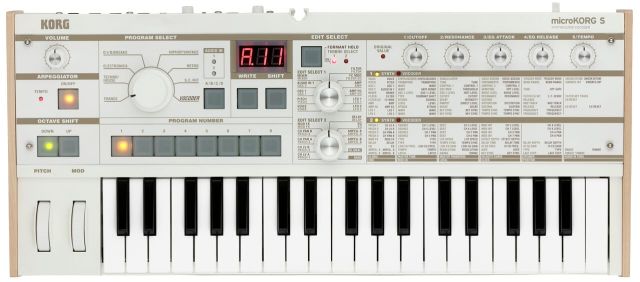
“Musicians who gravitate to microKORG can now choose a version that needs no additional speakers, monitors, or other connections to play,” says Korg’s James Sajeva. “The program memory capacity has also been increased twofold, and we’ve added 64 all-new preset programs.”
microKORG-S offers all of the original microKORG’s functionality, including ‘Big Knob’ genre selector for quickly selecting groups of presets, a four-band vocoder with an included microphone, arpeggiator and optional battery operation.
Pricing and Availability
The microKORG-S will be available in September of 2016 for $499.99. See the Korg site for details.
microKORG-S Specifications:
Sound Generation:
Analog Modeling Synthesis System
Synthesizer Programs:
Multi Timbres: 2 (max, Split/Dual Mode)
Maximum Polyphony: 4 voices
Structure: 2 Oscillator + Noise Generator
Multi Mode Filter (-24dB/oct LPF, -12dB/oct LPF/BPF/HPF)
EG x2
LFO x2
Virtual Patch x4
Vocoder Programs:
Maximum Polyphony: 4 voices
Structure: 1 Oscillator + Noise Generator
EG x1
LFO x 2
8 Channels vocoder
Level and pan of each channel can be edited
Formant Shift function
Programs:
256 programs (192 Presets / 64 Users)
Up to eight favorite programs can be registered
Effects:
Modulation effects: flanger / chorus, phaser, ensemble (3 types)
Delay: stereo, cross, L/R (3 types)
Equalizer
Arpeggiator:
6 types (UP, DOWN, ALT1/2, Random, Trigger), Step Arpeggiator function
Controls:
Real-Time control knob x5, Arpeggiator ON/OFF
Keyboards:
37-keys (mini-keyboard, velocity sensitive)
Inputs:
AUDIO IN 1 CONDENSER (with MIC/LINE switch, +5V, mini phone jack)
AUDIO IN 1 DYNAMIC (with MIC/LINE switch, 1/4” phone jack)
AUDIO IN 2 LINE (1/4” phone jack)
Outputs:
L/MONO, R (1/4” phone jacks)
Headphones:
(1/4” stereo phone jack)
MIDI:
IN, OUT, THRU
Amp Output / Speaker:
3 W / 4 cm x 1, 0.5 W / 3.5 cm x 2
Display:
3 characters x1 line with 8 segment LED
Power Supply:
DC 9V (AC adapter), or six AA alkaline batteries (sold separately)
Battery Life:
Approximately 4 hours or more (when using alkaline batteries)
Dimensions (W x D x H):
524 x 232 x 70 mm / 20.63″ x 9.13″ x 2.76″
Weight:
2.5 kg / 5.51 lbs.
(without batteries and included microphone)
Included Items:
AC adapter (DC 9V), Condenser Microphone
Accessories:
Soft Case: SC-micro-MSG
The system combines:
With their synthesis system, Percussa makes no attempt to conform to current status quo in synthesis, instead, trying to create a new generation of digital modular synthesizers.
- AudioCubes – a tangible wireless patching interface;
- SYNTHOR – powerful synthesis software; and
- REMOTE – a tightly integrated controller.
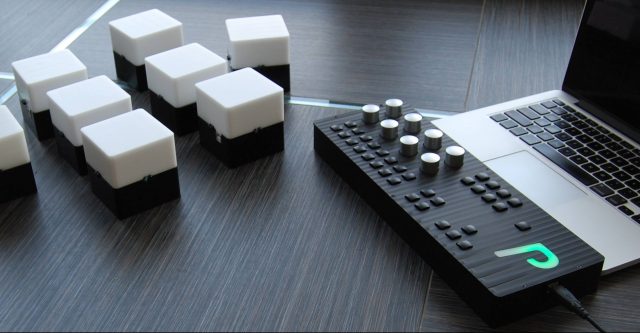
Percussa’s Digital Modular Synthesis System
SYNTHOR systems come with a wireless patching interface, which allows musicians and sound artists to patch synth modules in real-time, by placing AudioCubes, which represent the software modules, next to each other.
Moving cubes closer and further away changes the modulation depth of the signals flowing between the synthesis modules, allowing you to tangibly control more parameters simultaneously than is currently feasible with traditional hardware systems. Multiple patch connections between modules can be created simultaneously by placing cubes next to each other.
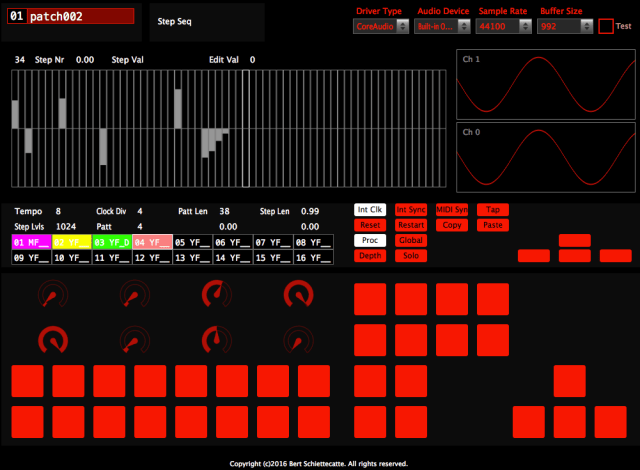
Synth modules are automatically assigned through the SYNTHOR synthesis software to each cube.
Percussa says that it is like having a virtual case of modules, offering the advantages of computer based synthesis, but with dedicated hardware interfaces for patching and parameter control.
SYNTHOR runs stand-alone on MAC and PC and needs no other software or plugins.
The SYNTHOR digital modular synthesis system has built-in visual feedback: synth modules, patch connections, show clock timings, and signal amplitude are all mapped to RGB colors and light intensity on the AudioCubes patching interface, giving you an instant overview of the state of the system at all times.
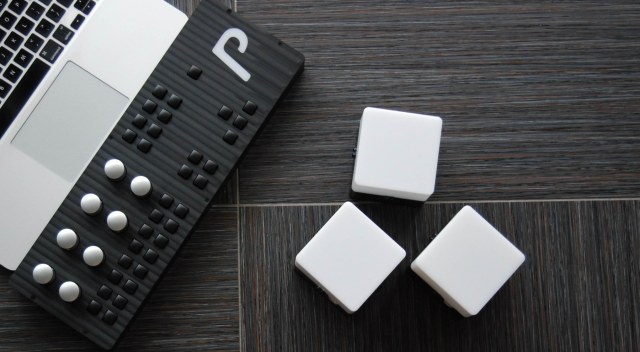
Percussa REMOTE
Modular synthesis setups are easily created using the tightly integrated REMOTE controller, which lets you configure AudioCubes and set parameters in the SYNTHOR synthesis software, without having to touch your computer or mouse.
Entire synthesis setups and module configurations can be easily created and switched with the press of a button on the REMOTE controller, and the AudioCubes patching interface instantly controls the new module setup. Presets can be exchanged online with follow musicians and artists.
Pricing and Availabilty
The SYNTHOR digital modular synthesis system is available now on the Percussa website, and comes in 2 versions:
The SYNTHOR synthesis software is included in both systems. Systems are expect to ship after KNOBCON.
- Percussa P8 (8 AudioCubes, 1 REMOTE); and
- P15 System (15 AudioCubes, 1 REMOTE).
Details on both systems are available on the Percussa site.
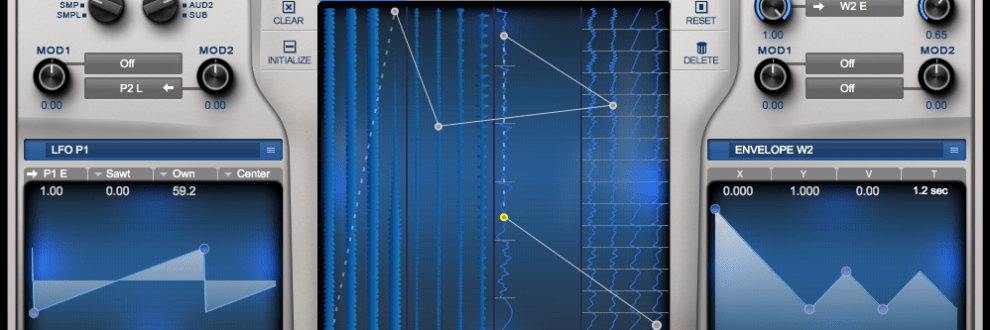
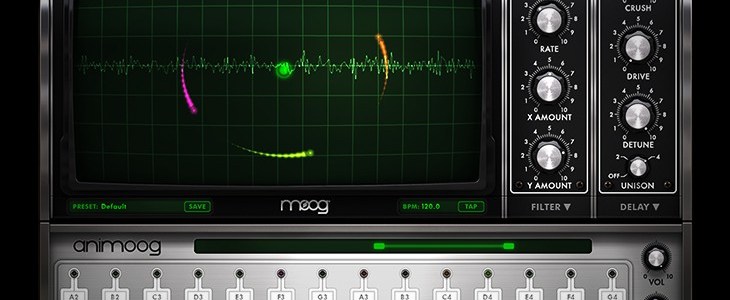
Moog has updated Animoog for iPad to version 2.4.0, adding support for the iPad Pro, Bluetooth LE MIDI, Multidimensional Polyphonic Expression and more.
Here’s what’s new in Animoog 2.4.0:
- Animoog now requires iOS 8.2 or later.
- Fully optimized graphics, keyboard layout and interaction for the 12.9-inch iPad Pro.
- Support for Apple Pencil pressure on the keyboard.
- Support for Apple Pencil angle as a ‘pencil-angle’ modulation control on the keyboard.
- Support for Apple Pencil angle as a ‘path-width’ modulation source along the path.
- Support for Bluetooth LE MIDI devices.
- Support for MPE input with note-per-channel MIDI controllers.
- Added collapsible Inter-App Audio transport bar.
- Consolidated ‘poly-pressure’ and ‘chan-pressure’ into one ‘pressure’ modulation source.
- The vertical position of the keys on initial touch is now used as the ‘velocity’ modulation source.
- Left and right tapping next to the scale slider will now transpose octaves down and up.
- Timbres panel improvements to make sound design easier.
- Single-tapping a timbre on the left panel now highlights it, while double-tapping scrolls to its location in the Timbres list.
- The Timbres list on the right panel is no longer collapsed when switching presets.
- Values of CC mapped controls are now sent out at preset changes.
- Incoming MIDI CC 120 now turns off all active sound.
- Incoming MIDI RPN 0 now sets the active pitch bend range.
- Minor user experience improvements when working with modal dialogs.
- Settings are now saved immediately when changes occur.
- Fixes to timbre list where auto-scroll would overshoot at times.
- Fixes to some built-in scale definitions.
Pricing and Availability
Animoog for iPad is available for US $29.99 in the App Store.
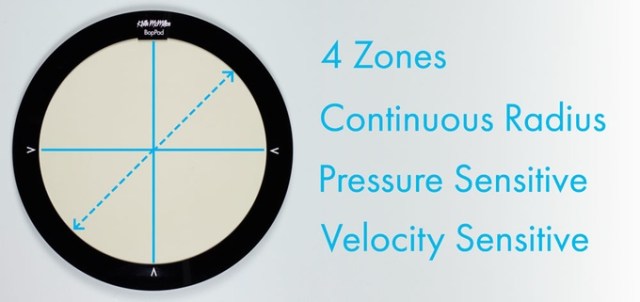
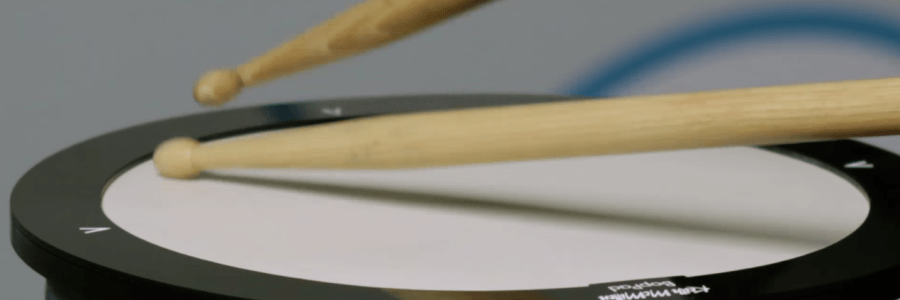
KMI says that BopPad has an extremely wide dynamic range and measures strike velocity from the softest hand drumming to ‘the most brutal percussive assault’. A robust tuned elastomer surface covers a 10” circle of KMI’s Smart Sensor Fabric, combining traditional feel and expression with modern capabilities.
BopPad Editor Software
The BopPad Editor software will be available as a desktop download and iOS app. KMI is even developing a WebMIDI version, so you can design presets for BopPad from anything that runs a web browser.
BeBop Smart Sensor Technology
BopPad takes advantage of Smart Sensor Fabric Technology from BeBop Sensors, Keith McMillen’s sensor technology company. At the core of BopPad is a single large sensor made from the 8th generation of BeBop’s Smart Sensor fabric.
Pricing and Availability
KMI is funding production of the BopPad via a Kickstarter campaign. This is KMI’s third Kickstarter project, and they have already raised about $5,000 of a $35,000 goal. The BopPad is available to project backers starting at $150.

Eine genial einfache Methode, den MicroKorg auf die Spielwiese der Boutiques und Refaces zu bringen, die ebenfalls Batteriebetrieb und eingebaute Lautsprecher bieten.der MicroKorg ist ebenfalls noch nicht am Ende - der kriegt jetzt eingebaute Speaker (!)



ROLI HQ
2 Glebe Road
Dalston
London E8 4BD
+44 (0) 207 254 2155



Wäre es nicht interessanter, wenn Eric Persing einen Hardware-Controller herausbringen würde, mit dem man seine Software komplett bedienen kann? Dafür würde er keine Kooperation mit Roland benötigen, sondern würde schon jemanden finden, der ihm den Controller entwickelt und baut. Dann hätte man den letzten Stand der Sound-Welt von Eric Persing zum Anfassen und Bedienen mit Hardware.
(wahrscheinlich nach Lizenzverhandlungen mit Eric Persing) größere Versionen davon in neue FAs, Integras und SonicCell-Nachfolger stecken würde.
Wäre es nicht interessanter, wenn Eric Persing einen Hardware-Controller herausbringen würde, mit dem man seine Software komplett bedienen kann?